
The point
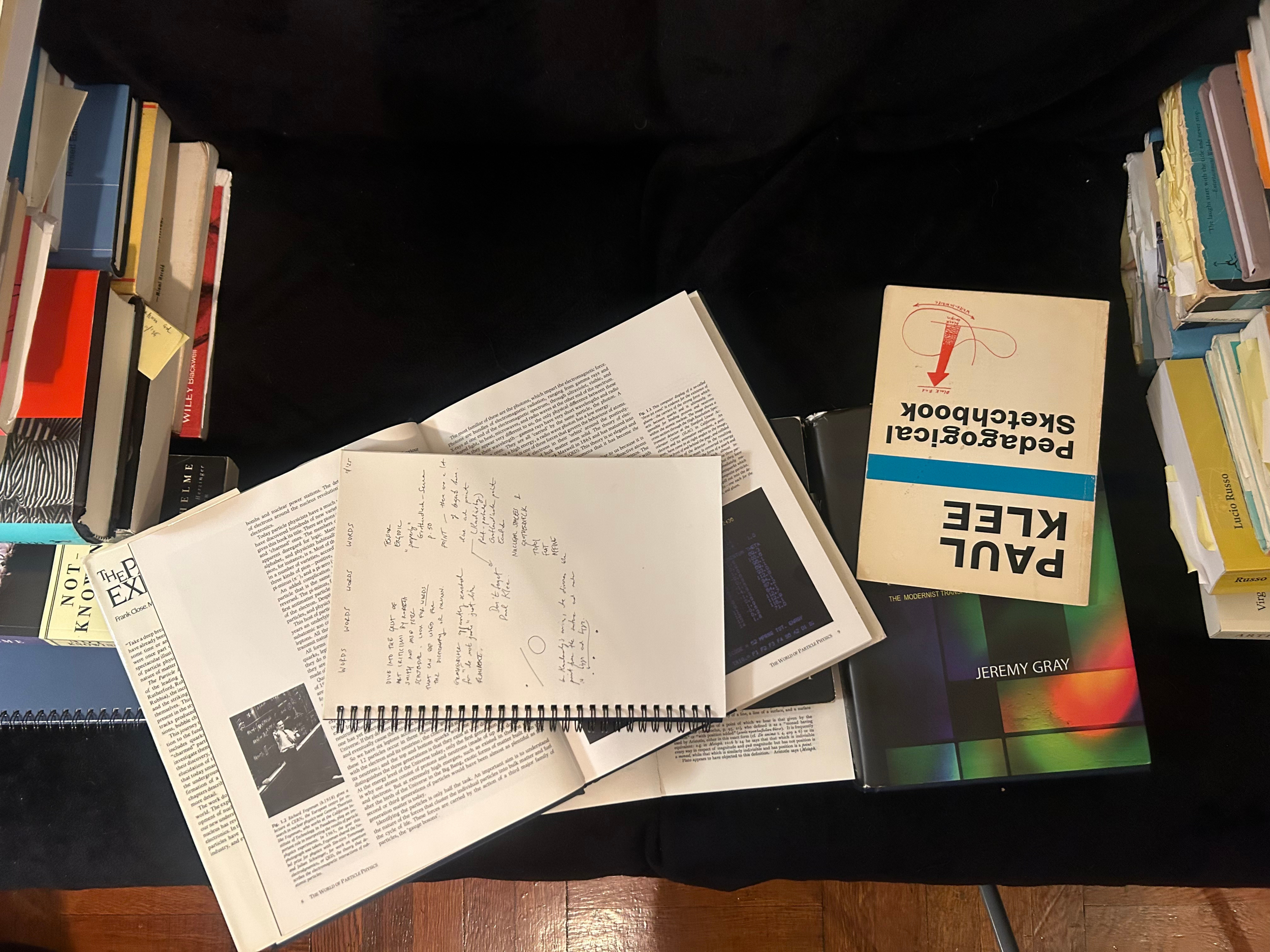
Paul Klee drew a squiggle and called it “an active line on a walk.” I was so floored by this that I wrote “Draw a Line. Now Take it on a Walk (and maybe bring a poop bag)” in my notes. Then I drew a line and I also drew a poop bag. That was the start of this idea. This piece is not about lines or about Paul Klee, though I did grab his Pedagogical Sketchbook this morning just in case.
POINT
Euclid calls a point “that which has no part.” But it has a little part. And you’ve just seen it. Twelve times! Not counting the caption. Which just saying that added two more dots and now this one added three. How long can I get stuck in this loop? A long time.
In physics, point particles are leptons, quarks and gauge bosons. We can safely say everything in our universe that ever was or ever will be is some combination of these points and their antimatter partners.
Sir Thomas L. Heath, definitive translator of Euclid, footnotes that you could translate Euclid’s sentence as “A point is that which is indivisible into parts.”
Aristotle called a point indivisible too. But he wrestled with this definition and picked fights with Plato because if a point is indivisible, is infinitely small, how do you place points together to make something divisible — a line? He concluded that a line is not made up of points. A point is made up of now, a piece of time so small it is not part of time at all. The line only forms once the point moves.
A mathematician that did not think points were indivisible was Grothendieck. For him points were rich. They carried Galois group actions. A point was a profinite circle.
Points caused chaos and disruption in 300 BC when the Greeks realized that you could not make a line with √2 number of points. Lines and points informed their entire worldview so this was a cataclysmic discovery, what Jeremy Gray calls “the erosion of the concept of number.”
Wassily Kandinsky Interruption
Kandinsky made the first works of art that made no sense whatsoever.* He is probably the reason people at museums rub their chins in profound contemplation even though they are deeply confused. He is probably the reason others go “my kid could draw that” even though they can’t. (His 1911 Impression III (Concert) is abstract, but you can maybe make out that this is a concert. Not so his next one: Picture with a Circle. It’s supposed to represent a musical score, but this isn’t obvious at all.) Kandinsky was also a writer. In the three sentences below, he moves the point from the end, where it belongs, to the middle, where it’s weird, to an illogical place near the start. Kandinsky is working hard to trying to strip the point of meaning:
Today I am going to the cinema.
Today I am going. To the cinema.
Today I. Am going to the cinema.
Then he “divorces” (his word) the point completely from its sentence. It rolls off and hangs underneath it.
If the size of the point itself, and of the empty space surrounding it are increased, the sound of the writing becomes diminished, and the sound of the point gains in clarity and stength (Fig 1). (Kandinsky 1928)
The sound of the point! His “Fig 1” is a giant dot and it’s probably the most straightforward thing Kandinsky has ever drawn. The point is now free:
Nonetheless, the point has been wrenched free from its habitual state and thus prepares itself for the leap from one world into another, in which it is emancipated from the tyranny of the practical-purposive, in which it begins to live as an independent entity, and where its subordination has inner purpose. This is the world of painting. (Kandinsky 1928)
In grade school the point is a point of confusion, i.e. in moments like “0.125 = 1/8”: the point and line separating two numbers — the point doing the heavy lifting, if we’re being honest — in two (seemingly different) sets of ways. Kids actually have a hard time believing these two things are related at all.
A similar finding is reported by Neumann (2001) who noticed that seventh graders had difficulties accepting that there could be a fraction between 0.3 and 0.6 (Vamvakoussi and Vosniadou, 2010)
What is the point?
I don’t know.
*A very good case was made for Hilma af Klimt being the first: Much of the press coverage emphasized the fact that af Klint had begun painting her nonrepresentational works in 1906, four years before the attempts of Kandinsky, long considered the father of abstract art. The Strange Afterlife of Hilma af Klint, Painting’s Posthumous Star, The New Yorker