
Square rooting the frog
Theories come and theories go. The frog remains. — Jean Rostand
Analyzing humor, as E.B. White famously said, is like dissecting a frog; few people are interested and the frog dies of it. — Teddy Wayne
FROG
The other day I came across Bob Mankoff’s 2013 TED talk “Anatomy of a New Yorker Cartoon.” Mankoff was a legendary and longtime New Yorker cartoon editor.
Mankoff basically says that humor mashes up two things that don’t go together. This is the theory of benign violation.
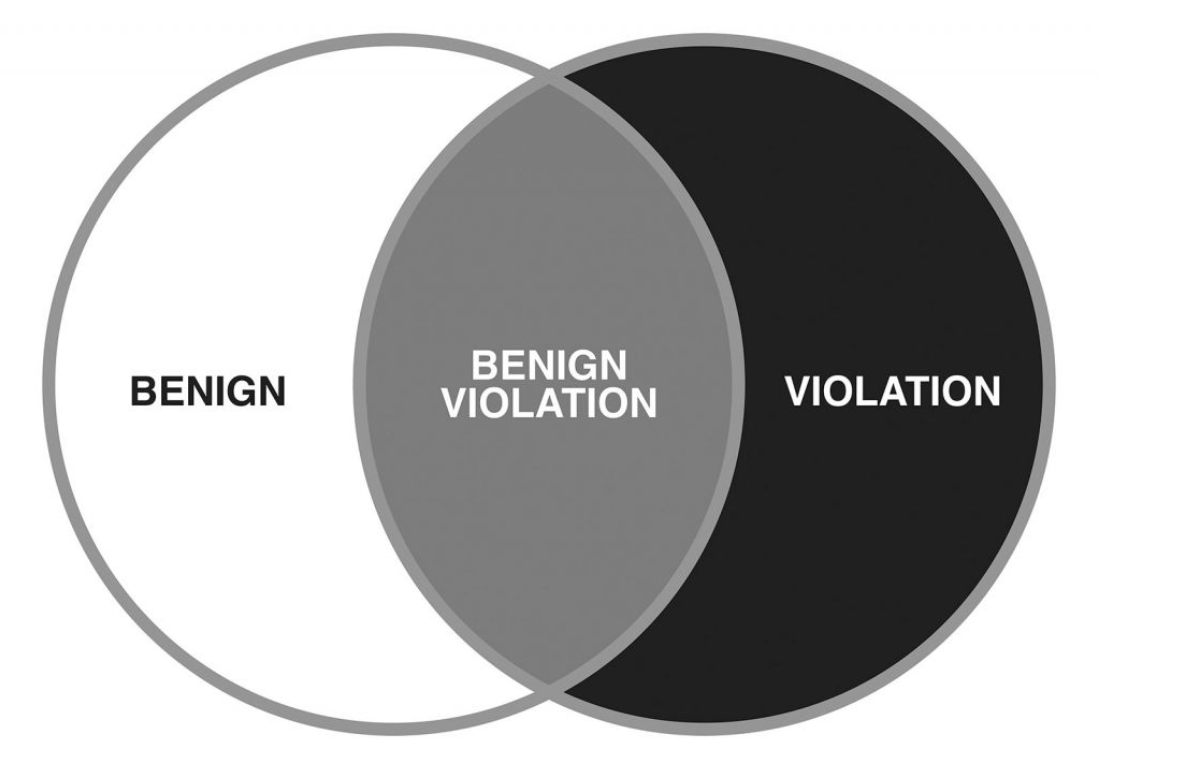
The Benign Violation Theory (image from Peter McGraw’s Humor Research Lab)
This means that if something is benign, it’s not funny. If something is a violation, it’s not funny. But a benign violation — a harmless subversion of what we expect — is funny.
The square root of a cow is a benign violation. This was a revelation to me because I was trying to be ridiculous, but not in a way that was grounded in any scientific reality. But when we see the words “find the square root of” we’re primed to expect a number or a variable to follow. A cow is the violation. (What’s the malignant violation of a square root!)
My reasoning for a prompt like this is that it flattens the concept of square root. Since nobody has taken the square root of a cow, there is no fear of getting it wrong. A fourth grader and a Field’s Medalist and a parent that’s forgotten everything from school can discuss the square root of a cow and everyone will sound equally dumb. When you divorce math from the strictures of “right” and “wrong” you are free to play with a mathematical idea. Maybe you will even understand it better.
But then look at this too!
…students who were taught class material with humor retained more of the class learnings, scoring 11 percent higher on their final exams. (Aaker & Bagdonis 2021)
Here is a string of benign violations at various levels. I’ll keep adding to this list. Some are on the cards and some aren’t:
Are parallel lines lonely?
Should the fraction bar be a squiggle?
Can you take the integral of cotton candy?
Can you flush a four-dimensional toilet?
What’s half a cookie times half a duck?
What’s a potato to the zebra power?
Find the Euler number of a lamp!
Would you ride the tangent curve roller coaster?
These are not quite benign violations but still verbal math exercises that are fun to explore:
DARK: Turn off the lights and describe an object using only its geometric properties. This forces you to use words like line, plane, circle and sphere. These are called manifolds in topology!
PET: Hold a pen or pencil to a piece of paper. Now take this line on a walk! (This was inspired by Paul Klee and referenced in the caption on this blog post.)
DOTS: Try to draw dots that are randomly far apart! This is an exploration of hyperuniformity.