
Trampolines & Socks: Crowdsourcing a math problem.
I want us to write the longest word problem ever together. But how? A meandering post that arrives at something of an idea.
HOW
Well, let’s start with the word problem. Here’s one from SAT Practice Test 5:
At a movie theater, there are a total of 350 customers. Each customer is located in either theater A, theater B, or theater C. If one of these customers is selected at random, the probability of selecting a customer who is located in theater A is 0.48, and the probability of selecting a customer who is located in theater B is 0.24. How many customers are located in theater C? (The College Board 2024)
I don’t know about you, but my patience took a nosedive right away and hit zero before the problem even ended. And this problem is only 70 words long!
We want a funny and engaging word problem that makes people happy. It will also be much longer than 70 words. Another issue with the problem above is that it unfolds in a logical way, and this won’t happen with random submissions. Plus it’s 3 sentences, not 1. So we can throw this whole word problem away. (Just kidding — a little.)
Problem 27 from the same test is 124 words long. But again it has flow, internal logic, and is more than one sentence long:
For an electric field passing through a flat surface perpendicular to it, the electric flux of the electric field through the surface is the product of the electric field’s strength and the area of the surface. A certain flat surface consists of two adjacent squares, where the side length, in meters, of the larger square is 3 times the side length, in meters, of the smaller square. An electric field with strength 29.00 volts per meter passes uniformly through this surface, which is perpendicular to the electric field. If the total electric flux of the electric field through this surface is 4,640 volts meter · s, what is the electric flux, in volts meters, of the electric field through the larger square? (The College Board 2024)
Man these are terrible. How does anyone take the SAT? Terribleness aside, something else is wrong with these two examples. There is no….well let me defer to Malcolm Lowry for this:
Sickness is not only in body, but in that part used to be called: soul. (Lowry 1947)
Okay, well, you get what I mean. These word problems have no soul.
Clearly the SAT is useless.
SOUL
To look at a long sentence outside of math, a sentence with nothing but soul, we turn to Lucy Ellmann. Why Lucy Ellmann? Because Lucy Ellmann wrote a sentence that is 426,100 words long. I happen to love Ducks, Newburyport and was enthralled with it years before I had this idea. (I have always loved sentences.) But let’s see how she pulls this off:
The fact that the raccoons are now banging an empty yogurt carton around on the driveway, the fact that in the early morning stillness it sounds like gunshots, the fact that, even in a fog, with ice on the road and snow banks blocking their vision, people are already zooming around our corner, the site of many a minor accident, the fact that a guy in a pickup once accidentally skidded into our garage, and the next time it could be our house, or child, Wake Up Picture Day, dicamba, Kleenex, the fact that a pickup truck killed Dilly, the fact that she’d successfully dodged cars for three whole years, the fact that…
I love this book, I love this sentence and I love this blurb. First, it showcases the whirlwind kitchen sink of thoughts racing through a woman’s head: fog, raccoons banging an empty yogurt carton, dicamba, ice, gunshots, Kleenex. And because she is a brilliant writer, there is a brilliant caveat that lets this go on and on and on without it being a run-on sentence: the fact that. From here, we can bounce in a million different directions and not break grammar rules: the fact that trees exist, the fact that dinosaurs are dead, the fact that I’m starving.
So I think (do you agree?) that we will need a little trampoline like “the fact that” so that our brave contributers are not dealing with the terror and inertia of a blank page. The trampoline, our short head start, should also hook nicely onto the previous clause, whatever it is about. We can do away with internal logic but still have a long, grammatically correct independent clause.
THE TRAMPOLINE
There should be an emotional element here. You should be able to walk by a clause and resonate with what you’re reading:
Maggie Murtha, part of the project team at the M.T.A., said one of her takeaways from the focus groups was that “there was a longing to feel connected to the people around you.” (New York Times 2025)
Maggie Murtha is talking about an incredibly cool art project conceived of by the artist Chloe Bass wherein 10-45 second messages of hope played over the P.A. system at select New York City subway stations. I like the idea of the subway system because it is my happy place (actually) and also a place where people have the time to gripe about delays and read things. Plus the MTA is very supportive of public art projects. Which is to say this is a moment we can use to connect with the millions of people who have emotional anxiety around math. And perhaps the trampoline should reflect that.
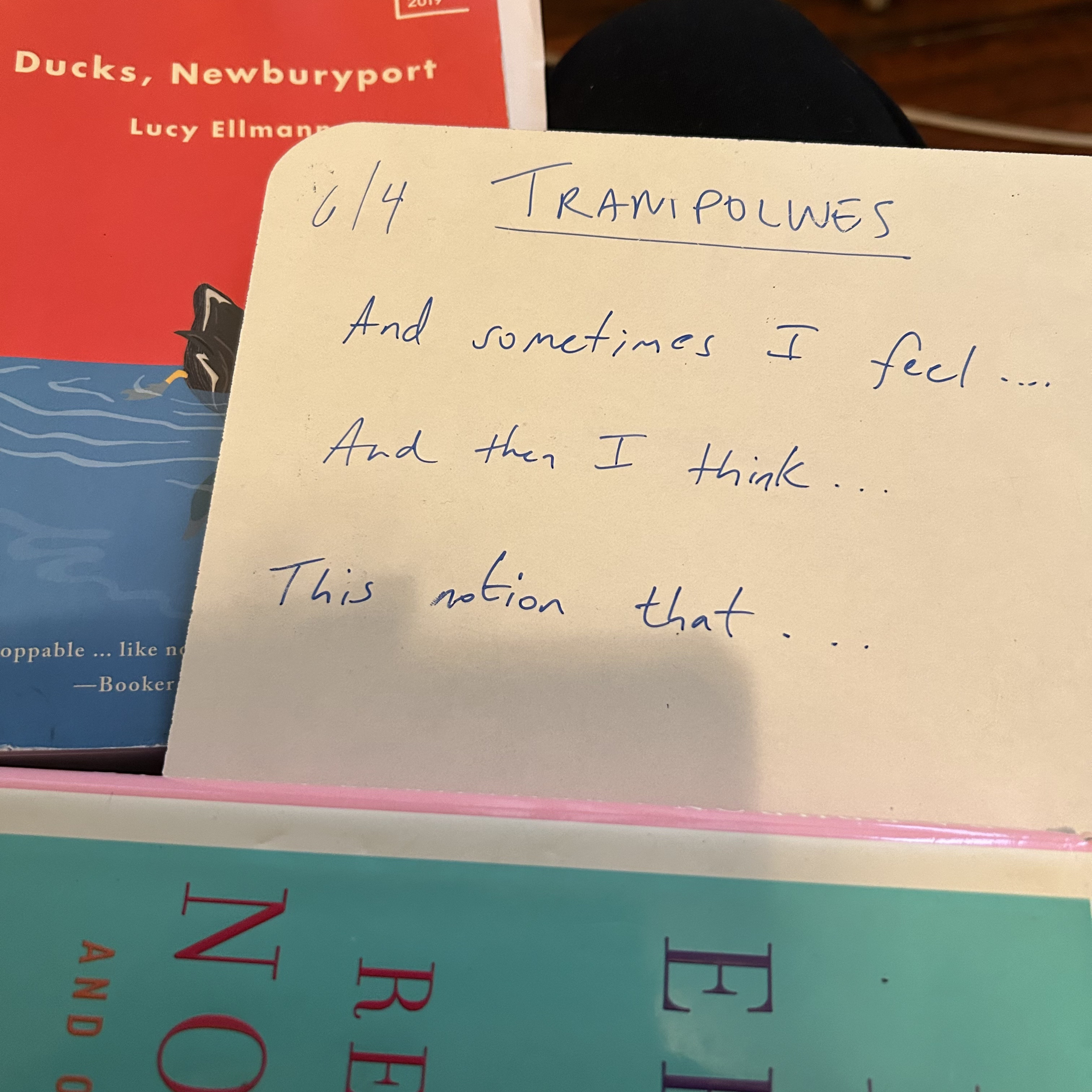
Here are some ideas. Can you read the scribble? It says:
And sometimes I feel….
And then I think…
This notion that…
Even geniuses have insecurities about math right? So perhaps these are universal and clauses we can all extend. But how will it be a math problem?
MATH TRAMPOLINES?
Okay that phrase needs some tweaking. But would it mean something to have moments of the math problem in between clauses of anxiety and insecurity? Another option would be to have the start and the end be the only clauses containing a math problem. And perhaps an extremely simple one:
an idea
[We had 15 apples] many hundreds of words later [but ate 3, and how many apples will that leave us with?]
We can also ask mathematicians to supply the math clauses, in a kind of artistic tapestry between anxiety and computation:
another idea
…and sometimes I feel that math is not for me, all 28 apple pies being ransacked by bears, this notion that you need to be fast in order to math correctly…
So perhaps the math trampolines can look like this:
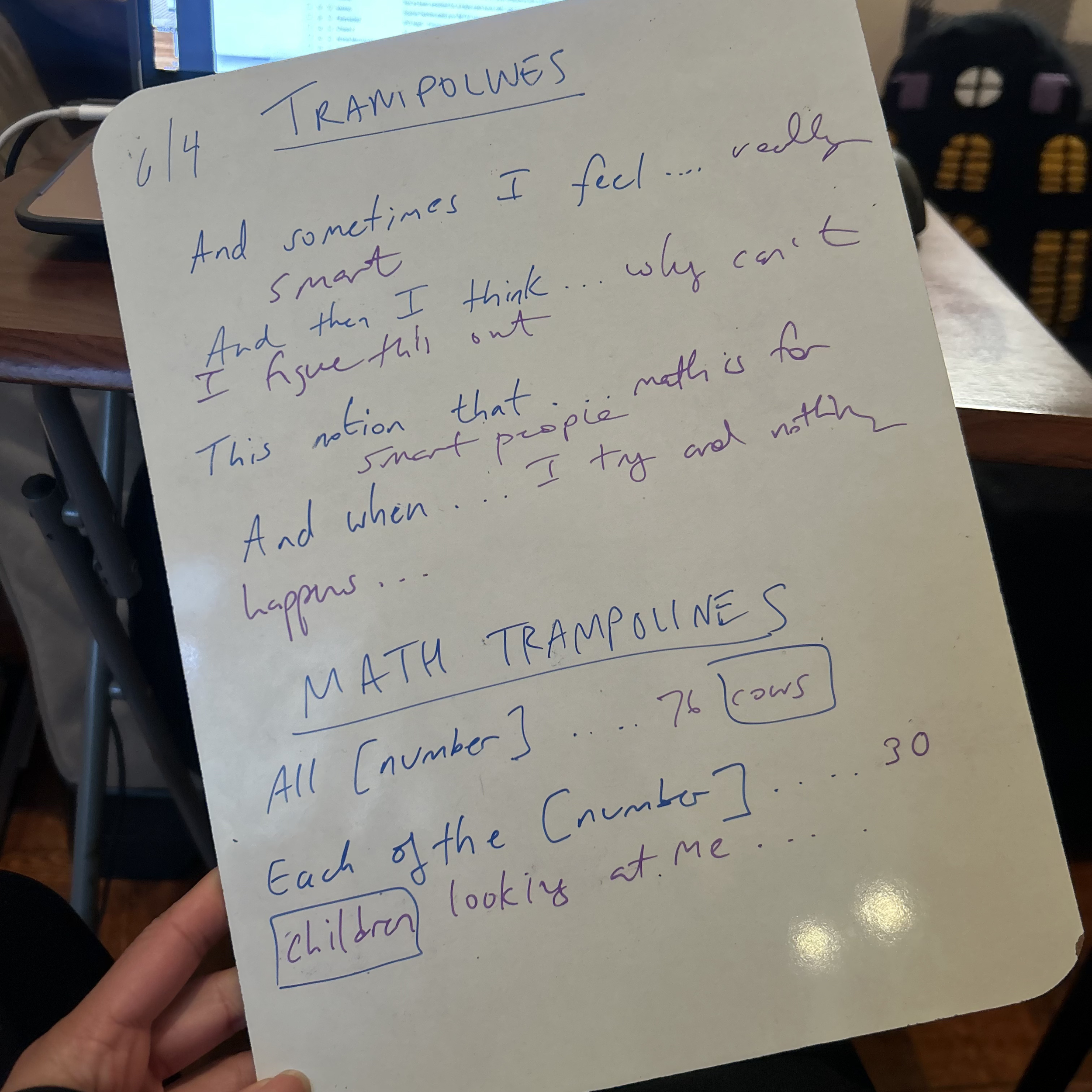
If that’s too dark, the “math trampoline” running starts are “all [number]” and “each of the [number]” which can lead to something like this:
……and sometimes I feel that math is not for me, all 28 apple pies being ransacked by bears, this notion that you need to be fast in order to math correctly, and when I try it’s never good enough, each of the 30 children looking at me, and then I think I’ve found the solution, all 76 cows grazing…
I think we are almost there! But something is still off. It doesn’t make sense to have 28 apples pies and then 30 children and 76 cows. None of these quantities are related.
But what if the noun is consistent? Then we can have soul and internal logic. Take cows:
……and sometimes I feel that math is not for me, all 28 cows being cuddled [I couldn’t “bear” ransacking] by bears, this notion that you need to be fast in order to do math correctly, and when I try it’s never good enough, each of the 30 cows looking at me, and then I think I’ve found the solution, all 76 cows grazing…
Okay but what are the cows doing? You can’t really get rid of cows. Maybe the word should be something universal and likable and edible like…pizza? Cookies? Or socks! Socks get famously lost and are also always in word problems. Plus we all own socks!
It might be socks.
SOCKS AND TRAMPOLINES
So here’s what we need to do, and I will try to see if we can stick the landing with a very long funny sentence that can go on forever.
TRAMPOLINES
This can be a thought. I might provide the option to talk out what you’re feeling.
And sometimes I feel…like math is really hard
This notion that…you have to be fast or some sort of genius to do math, does anyone else feel this way
But then I think….I can’t understand any of it at all
And what if….all geometry disappeared
And I wonder….are there some things I’m just not good at
SOCKS
The socks option involves stating a non-infinite number of socks + something, anything, happening to said socks:
85 socks in the dryer
2 socks getting thrown away
11.342314 socks in the blender
4 socks my mom bought
-3 socks from my cat
THE TENTATIVE RESULT
This notion that you have to be fast or some sort of genius to do math, does anyone else feel this way, 85 socks in the dryer, and sometimes I fee like math is really hard, 2 socks getting thrown away, but then I think I can’t understand any of it at all, 11.342314 socks in the blender, and what if all geometry disappeared, 4 socks my mom bought, and I wonder are there some things I’m just not good at, -3 socks from my cat…
I do think this can keep going. We might have something.
Ellman, Lucy. Ducks, Newburyport. Bilioasis. (2019)
Lowry, Malcolm. Under the Volcano. J. B. Lippincott. (1947)