
I just want to say: The Princeton Companion to Mathematics
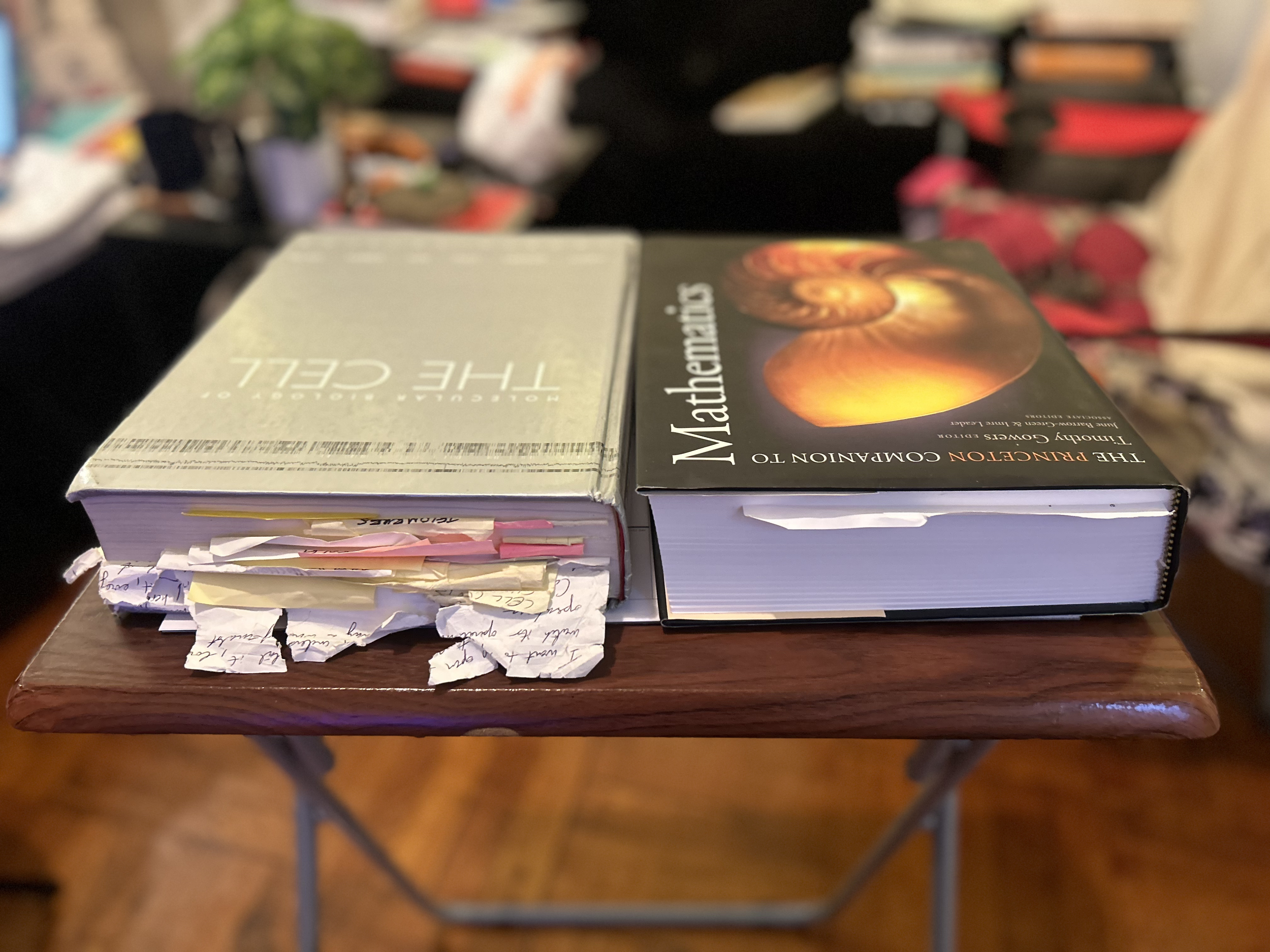
For years, decades actually, I’ve hauled Molecular Biology of the Cell (Alberts et. al 2002) with me every place I live. I’ll never part with, at least voluntarily. It is a door stopper, a poster flattener, a dumbell, my weapon of choice in a home invasion, and, occasionally, a place to read up on paths of diffusion through the nuclear pore complex.
My copy of MBOTC — the silver version with the boring cover — is 7.6 pounds. Charles Darwin once said his deep regret in life was not being a man of mathematics, for such men are endowed with extra sense. In honor of Darwin, let’s do a calculation for no reason: Molecular Biology of the Cell is 1,000,000,000,000,000,000,000,000,000,000 times bigger than the subject it covers.
But MBOTC has a match, a twin, an antiparticle: The Princeton Companion to Mathematics. This book is equally gigantic and expansive but the similarities end there. MBOTC and TPCTM are perfect inverses. While MBOTC plunges into a microscopic world and expands it, TPCTM sets its eyes on a subject that is infinitely large and collapses it.
This is achieved in an expert manner because TPCTM is edited by Timothy Gowers, a Fields Medalist.
The book defies categorization. It’s not a textbook and it’s not a dictionary — but it’s more dictionary than textbook. Some entries are one paragraph long. Some are little novellas. There are sections on the language and grammar of math, on the general goals of math, on mathematicians, and even math melodrama (like the parallel line stuff, or the time Kurt Gödel ruined everything). This is the only book I know where you can read about probability and inequalities and Wardrop equilibria and Hilbert's Nullstellensatz. All the entries contain entry points to other entries and before you know it you are bouncing from MANIFOLDS on page 244 to RICCI FLOW (by Terence Tao, another Fields Medalist) — but might you also consider DIFFERENTIAL TOPOLOGY (396), ALGEBRAIC GEOMETRY (363), or MODULAR SPACES (408)?
One of the best things to do is open the book with no plan in mind. Today I landed on “Higher Genus Moduli Spaces and Teichmüller Spaces,” part of a family of articles on moduli spaces written by renowned mathematician David Ben-Zvi. Do I understand it? Not really. But it is more English than not, more words than numbers, and with each entry you feel like you are being let in on a little secret.
PS: Years ago I’d commute to New York from New Jersey. On my way home, I’d stop at Barnes & Noble and flip through The Princeton Companion to Mathematics. This year, I decided to actually buy the thing. (That’s why it’s so pristine.) The back of the napkin calculation was done using data from another great book called Cell Biology by the Numbers. I should also add that there is an entry on cell biology in The Princeton Companion to Mathematics! (pages 837-848)