
Why writers should read math proofs
There is a lot of great writing in math. There are sentences with rhythm and even sentences that are funny. But this is about words.
In Pete Wells’s New York Times review of Eleven Madison Park, he writes:
In tonight’s performance, the role of the duck will be played by a beet, doing things no root vegetable should be asked to do. (Wells 2021)
See the “performance” of a familiar word in mathematician Alexander Grothendieck’s 1,900 page Récoltes et Semailles (a book nobody has ever finished, not for lack of trying):
The deepest (to my eyes) of these twelve themes, are the notion of motives, and the closely related yoga of nonabelian algebraic geometry, and Galois-Teichmüller theory. (Grothendieck 1986)
Here the word “yoga” shares a sentence with nonabelian algebraic geometry, of all things! Where else in math were familiar words doing stints in unfamiliar roles? I needed to nose around.
In this monograph, conventional subjects — symmetric group, Lie algebras (and, to a lesser extent, continuous Lie groups) — are presented in a somewhat unconventional way, in a flavor of diagrammatic notation that I refer to as “birdtracks.” (Cvitanović 2008)
All this time, birdtracks have been used as a way to simplify index notation.
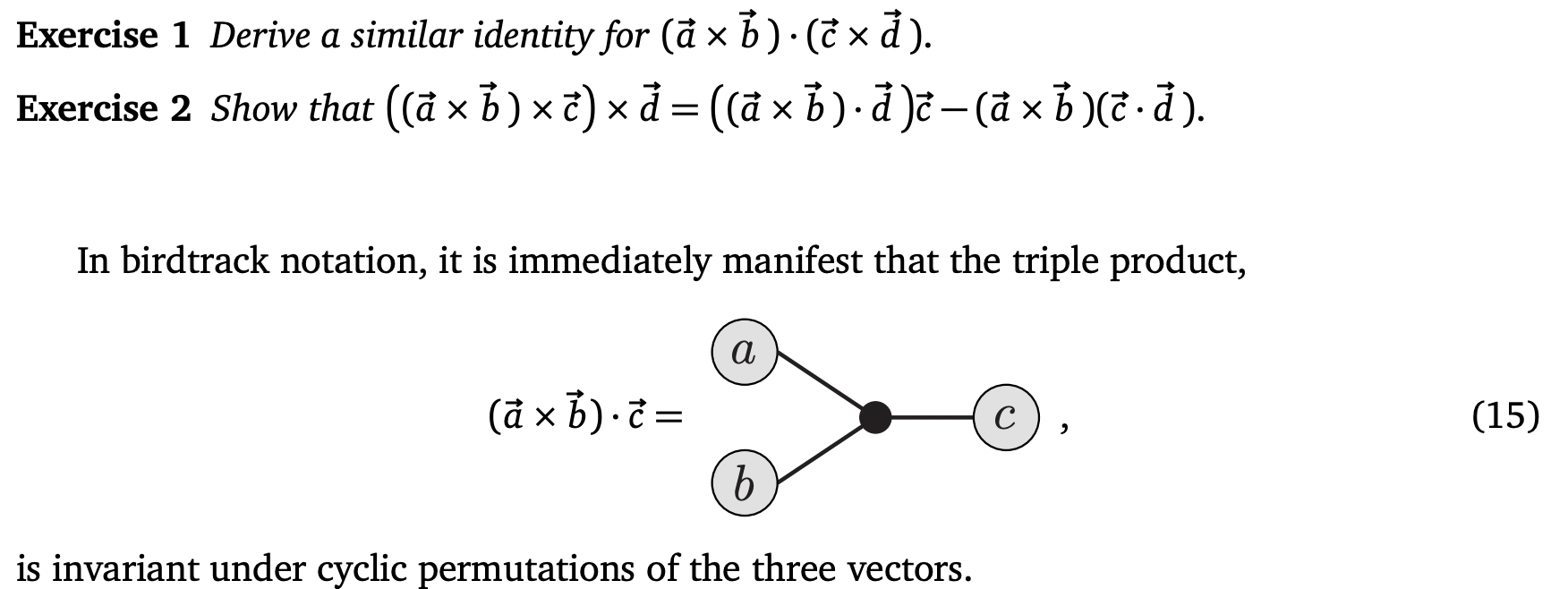
A little depiction of birdtrack notation. Stefan Keppeler. “Birdtracks for SU(N)” SciPost Phys. Lect. Notes 3 (2018) · published 27 September 2018. Note that with a space (“bird tracks”), you are back to using footprints in the sand to track if you have a webbed, totipalmate, or zygodactyl bird.
I had to keep looking (boldface mine):
When working with a Coxeter group, one is sooner or later faced with problems concerning the combinatorics of reduced words. When do two such words represent the same group element? (Bjorner 2000)
In this case it is natural to make a surgery by cutting open the neck and gluing small caps to each of the boundaries, and then to continue running the Ricci flow. (Perelman 2024)
Just as the Dirac gamma matrices lead to spinor reps of SO(n), the Grassmann valued γµ give rise to Sp(n) reps, which we shall call spinsters. (Cvitanović 2008)
Yoga, birdtracks, words, surgery, spinsters! You know who loves this kind of thing? Writers. Writers are word watchers and get a serious thrill when a fellow writer deploys a word in an unexpected way. Lydia Davis writes glowingly about Samuel Beckett’s spin on the word “dint”:
There was his precise and sonorous use of the Anglo-Saxon vocabulary — especially, in this example, the way he gives a familiar word like dint a fresh life by using it in an unfamiliar way. (Davis 2019)
Francine Prose writes about F. Scott Fitzgerald’s unexpected use of “deferential” to describe a row of palm trees. Donald Barthelme paid close attention to what Edward Gorey did with “it” in the sentence “Last night it did not seem as if today it would be raining”:
The meeting of the “it” which did not seem and the “it” which would be raining is inspired. (Barthelme 1997)
It’s equally thrilling to find these words as a reader. I can’t think of anything more prosaic than a paragraph. Francine Prose calls it a “literary respiration.” Sloane Crossley imagines Dorothy Parker’s “delight in filleting a book.” InTrout Fishing In America, Richard Brautigan mistakes a woman for a trout stream:
I remember mistaking an old woman for a trout stream in Vermont, and I had to beg her pardon. “Excuse me,” I said. “I thought you were a trout stream.” (Brautigan 2010)
William Vollman made “flypaper” a verb. William Faulkner called an empty road a postulate.
Isn’t it magical that mathematicians and writers are playing with words in similar ways?
IRRATIONAL MANNINGFALTIGKEIT
The link between words and math is ancient and storied. For over 2500 years, mathematicians have had to use the vocabulary of their time to give “text-clothes” to the inexplicably abstract contours of their world. Take irrational. This word burst onto the scene, uninvited, because nobody could measure the diagonal of a square. In 300 BC, everything could be neatly expressed as the ratio of integers or line segments. But the length of the square’s diagonal was √2, a number that did not exist. This was profoundly disturbing. Here is Lucio Russo writing about this episode in The Forgotten Revolution:
If we discover that a scientific theory is contradictory, it’s no big deal: we change theories. But what can we do if we discover, or think we have discovered, a contradiction in reality itself? (Russo 2000)
The event exploded the concept of a number. 100 oxen were sacrificed. It’s rumored someone died. “Irrationalis” is a calque of the Greek ἀλόγος: √2 is called irrational because there is simply no ratio.
And now we have this word.
In 1854, Bernhard Riemann gave a lecture on space that would change the world (and give Einstein a geometric scaffold for relativity). Riemann called a set of points Mannigfaltigkeit which became manifold. In 1891, Georg Cantor, inventor of set theory, called his set of points Mannigfaltigkeit too (“Uber eine elementare Frage der Manningfaltigkeitslehre”). His Mannigfaltigkeit became “Menge” and Riemannian manifolds remain.
***
I was at the library in middle school and for some reason checked out Fermat's Last Theorem: Unlocking the Secret of an Ancient Mathematical Problem. I didn’t know Fermat (and pronounced the “t” in his name well into my 30s) but the book was short and “ancient mathematical problem” sounded promising.
Well this book blew my mind. The idea of Andrew Wiles sitting at a desk doing a math problem — a math problem! — for seven years was the most diabolical thing I’d ever heard. I couldn’t get it out of my head. (Turns out Grigori Perelman did basically the same thing ten years later with the Poincaré Conjecture.) These people were either a variety of bored beyond all Earthly comprehension or math was more interesting than The Establishment was leading on. I was leaning towards the latter because this world was bursting with words that set fire to my imagination. Here’s Wiles:
Using this, we complete the proof that all semistable elliptic curves are modular. (Wiles 1995)
Semistable! Elliptic! Modular! There are so many more! Rings, unramified cohomology classes — I mean who has ever seen “ramify” conjugated this way? — isomophism, homomorphism.
I had a vague grasp of Wiles’s proof at 13. Not because I was a math genius but because the guy who wrote that book, Amir Aczel, was a damn good writer. Intermission time.
INTERMISSION
If being a math genius is this pink dot: .
I’m having coffee on a faraway galaxy where, not only do I fail to see the dot, but the concept of “dot” doesn’t exist because light from this blog won’t reach me until the universe has exploded. That’s how far away from being a math genius I am.
INTERMISSION FINISHED
All of these words were interesting. This world was interesting. But not everyone wants to plod through grad school to get there. Not everyone can! Besides, what if you don’t even like math? What if you never learned math past 4th grade? Does that mean you should be totally shut out from all of this stuff?
No it absolutely does not.
Five days ago, I attended — well, crashed — a talk at the Courant Institute. I say crashed because this security guard was not messing around. That’s when the speaker, a mathematician at the Institute of Advanced Study at Princeton, came out to use the bathroom and I flagged him down. This wonderful soul was greatly confused but happy to let me in. I now know you have to be on a list to attend the Oscars, the MET Gala, and math seminars at Courant.
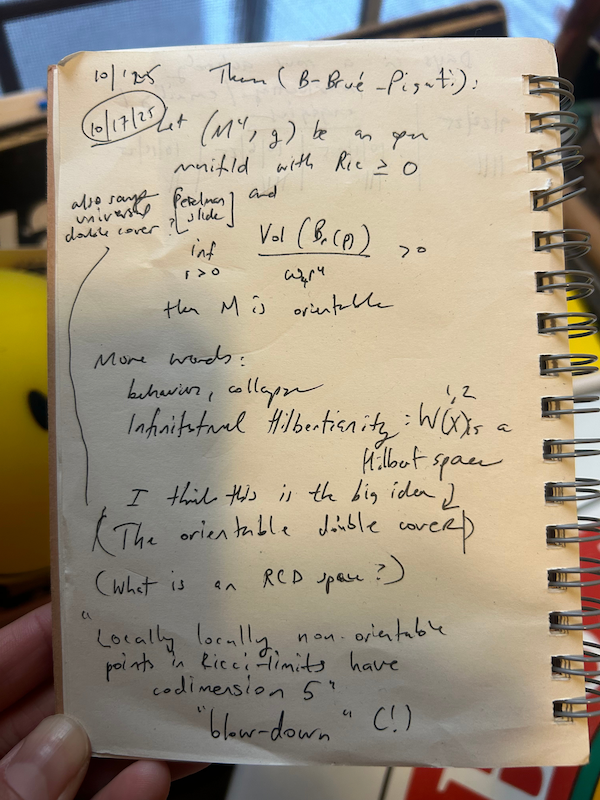
While this speaker, a bona fide math genius, made some very salient points and proved an important new result, I’m sure, you can see from the exclamation point at the bottom that my biggest thrill came from seeing “blow-down” on a math slide. Here it is in the paper:
The proof of Theorem 1.2 is analogous, but the contradicting sequence is obtained by blowing down (M4 , g). Indeed, the blow-down of a manifold with Euclidean volume growth is a metric cone and, again by [10], the cross-section of the latter is orientable. (Brena 2024)
I thought about “blow-down” all the way home. “Blow-down” was the most exciting thing I’d seen since Faulkner called an empty road a postulate.
This post is for writers and word lovers. If you hate math, gorge on a hidden secret: its words.
Barthelme, Donald. Not-Knowing: The Essays and Interviews. Counterpoint. (1997)
Bjorner, Anders & Brenti, Francesco. Combinatorics of Coxeter Groups. Springer. (2000)
Brautigan, Richard. Trout Fishing in America. First Mariner Books. (2010)
Brena, Camillo et. al. “Lower Ricci Curvature Bounds and the Orientability of Spaces.” arXiv:2412.19288
Cvitanović, Predrag. Group Theory: Birdtracks, Lie's, and Exceptional Groups. Princeton University Press (2008)
Davis, Lydia. Essays One. Picador. (2019)
Grothendieck Circle, Chapter 3. https://webusers.imj-prg.fr/~leila.schneps/grothendieckcircle/Mathematics/chap3.pdf
Grothendieck, Alexander. Récoltes et Semailles. (1986)
Parker, Dorothy. Constant Reader: The New Yorker Columns 1927-28. Forward by Sloane Crosley. McNally Editions. (2024)
Perelman, Grisha. “The entropy formula for the Ricci flow and its geometric applications” https://arxiv.org/abs/math/0211159v1
Prose, Francine. Reading Like A Writer. Harper Perennial. (2006)
Serre, Jean-Pierre & Colmez, Pierre. Grothendieck-Serre Correspondence (English and French Edition). American Mathematical Society (2022) https://webusers.imj-prg.fr/~leila.schneps/grothendieckcircle/Letters/GS.pdf
Russo, Lucio. The Forgotten Revolution: How Science Was Born in 300 BC and Why It Had to Be Reborn. Springer (2000)
Vollman, William. You Bright & Risen Angels. Penguin Group. (1987)
Wells, Pete. “Eleven Madison Park Explores the Plant Kingdom’s Uncanny Valley.” New York Times. (2021) https://www.nytimes.com/2021/09/28/dining/eleven-madison-park-restaurant-review-plant-based.html
Wiles, Andrew John. Modular elliptic curves and Fermat’s Last Theorem. Annals of Mathematics, 141 (1995), 443-551. http://www.scienzamedia.uniroma2.it/~eal/Wiles-Fermat.pdf
Williams, Gilda. How to Write About Contemporary Art. Williams writes about about how art theorist Boris Groys suggests that words give art “protective text-clothes.”